
Pond-Based Integrated Livelihood System
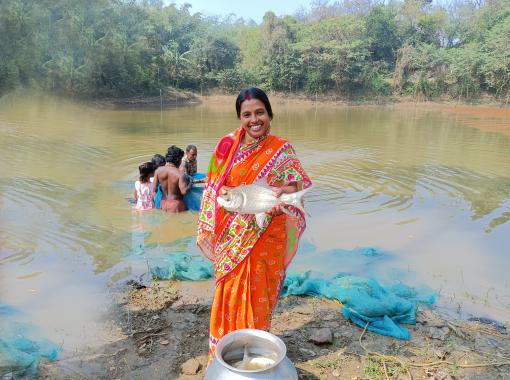
Pond-Based Integrated Livelihood System
About the Model
This integrated livelihood model demonstrates how rural communities can transform traditional subsistence practices into climate-resilient and income-generating enterprises through the sustainable use of local land and water resources. Implemented in the Kharagpur region of West Bengal, the model brings together fish farming, duck rearing, pond bund vegetable cultivation and organic horticulture into a circular ecosystem that enhances food, income and ecological security.
Focusing on
small and marginal farmers, particularly from SC and ST communities, the
approach emphasizes women’s participation and leadership in collective
governance. The model showcases how every pond can serve as a sustainable
micro-asset, supporting multiple sources of livelihood while maintaining
environmental balance.
Through scientific training, local innovation, and participatory learning, farming families have achieved tangible outcomes — improved nutrition, higher incomes and increased climate resilience. Households have reduced their dependence on external food and inputs, while women-led Self-Help Groups have taken charge of production, record keeping and financial management.
The outcomes demonstrate the power of convergence between natural resource management and livelihood security: over 20,000 kg of fish, 38,000 duck eggs and 40,000 kg of vegetables were produced, ensuring both food sufficiency and market-linked earnings. This integrated model has proven to be a scalable and replicable approach for climate-smart rural development — advancing multiple Sustainable Development Goals (SDGs 1, 2, 5, 8, 12 and 13) through innovation, inclusion, and ecological renewal.